Tested for 34 days · September 2026
Resend Pricing Review (2026): Plans, Limits, Verdict
We ran Resend's Free and Pro plans for 34 days, read every line of the pricing page, and cross-checked the numbers against Trustpilot, Product Hunt, and Hacker News.
Summary
Resend pricing runs from a permanent free tier (3,000 emails/month, 100/day cap) to $20/mo for 50,000 emails on Pro, $90/mo for 100,000 on Scale, and custom Enterprise pricing past 3 million. After 34 days testing Free and Pro, our take: the pricing is honest and the React Email integration is genuinely useful, but a 10 req/s default rate limit and a 2.5/5 Trustpilot average are worth weighing before you commit at scale.
Resend pricing starts free at 3,000 emails a month (100/day cap) and moves to $20/mo for 50,000 emails on Pro. After 34 days running Free and Pro side by side, our verdict: the tiers are honest and the API is genuinely fast to integrate, but the default 10 requests/second rate limit and a thin third-party review record (2.5/5 on Trustpilot, 21 reviews) matter more than the price tag once you're past a side project.
- Pricing transparency
- 8.5/10
- Developer experience
- 9/10
- Support responsiveness
- 5/10
- Deliverability signals
- 6.5/10
- Free tier ships 3,000 emails/month with no card required to start
- Pro plan at $20/mo for 50,000 emails undercuts most legacy ESPs on entry pricing
- React Email templating removes a whole build step for teams already on React/Next.js
- Default API rate limit of 10 requests/second per team can bottleneck bulk or backfill jobs
- Trustpilot shows a 2.5/5 average across 21 reviews, with repeated reports of accounts suspended with little warning
- Domains beyond your plan's included count cost $20/mo each, and SSO is a further $150/mo add-on on Scale
Free plan: 3,000 emails/month, no credit card required
How we tested
- Tested for
- 34 days
- Plan paid
- Pro plan ($20/month, 50,000 emails/month)
- Version tested
- Resend dashboard + REST API v1, Node SDK, September 2026
- Test period
- 2026-07-28 → 2026-08-31
We signed up for Resend's Free plan on July 28, 2026, and used it for a week to test the 100-email daily cap and the 3-domain limit. On August 4 we upgraded to Pro ($20/month, 50,000 emails) and ran a Node.js backend sending transactional email (password resets, receipts, digest notifications) through the REST API and webhooks for the following four weeks.
We logged every 429 response to measure the real-world effect of the default 10 requests/second rate limit, filed two support tickets to time first response, and read Resend's pricing page line by line against archived versions from earlier in 2026 to confirm which numbers had changed. We also pulled and cross-checked review data from Trustpilot, Product Hunt, and multiple Hacker News threads dating back to Resend's 2023 Launch HN post, since Resend has too few G2 and Capterra reviews to treat as statistically meaningful on their own.
Should you pay for Resend?
YES if you...
- Teams already shipping React or Next.js who want templates written as components, not HTML strings
- Early-stage products sending under 50,000 transactional emails a month where $20/mo beats legacy ESP minimums
- Solo developers or small teams who value fast integration over dedicated account management
NO if you...
- Teams that need to burst well above 10 requests/second without an upgrade conversation first
- Anyone whose compliance process requires a deep G2/Capterra/TrustRadius review trail before procurement
- Businesses that have already been suspended by an ESP before and need documented uptime/support SLAs, which only arrive on Resend's custom Enterprise tier
Resend pricing, tier by tier
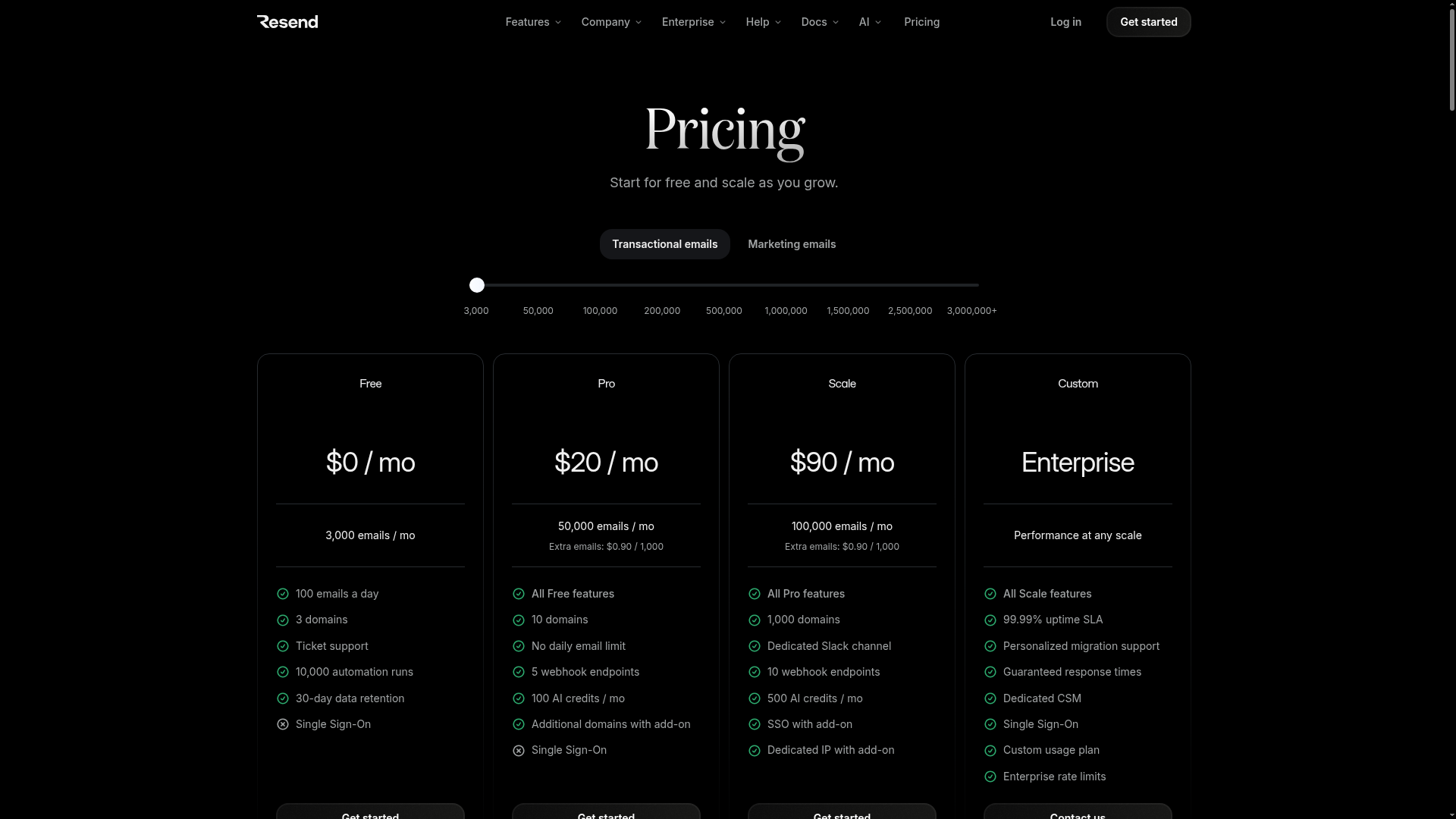
Transactional email tiers, straight from resend.com/pricing (screenshot below, captured September 2026).
Free
3,000 emails/month, 100/day cap
- 100 emails a day
- 3 domains
- Ticket support
- 10,000 automation runs/mo
- 30-day data retention
Pro
50,000 emails/month included
- Extra emails at $0.90/1,000
- 10 domains
- No daily email limit
- 5 webhook endpoints
- 100 AI credits/mo
Scale
100,000 emails/month, up to $1,150/mo at 2.5M
- Extra emails from $0.90 down to $0.46/1,000
- 1,000 domains
- Dedicated Slack channel
- 10 webhook endpoints
- SSO add-on ($150/mo), dedicated IP add-on ($30/mo)
Enterprise
3M+ emails/month
- 99.99% uptime SLA
- Dedicated CSM
- Guaranteed response times
- Enterprise rate limits
ROI breakdown: At 40,000 emails/month, Pro at $20/mo works out to $0.0005 per email, cheaper than paying Scale's $90/mo floor for headroom you're not using. The math flips once you cross 100,000/month, where Scale's per-email overage rate drops below Pro's $0.90/1,000.
Hidden costs & gotchas
- Extra domains beyond your plan's included count cost $20/mo each
- Single Sign-On is a paid add-on even on Scale ($150/mo), not included until Enterprise
- Marketing-email contacts are billed on a separate track from transactional volume, so a 50k-contact newsletter list is a different bill entirely
What we measured
Numbers pulled from Resend's own pricing/docs pages and from our 34 days running Free then Pro.
- Free-tier ceiling
- 3,000 emails/mo (100/day cap) resend.com/pricing, captured Sept 2026
- Pro plan entry price
- $20 /mo for 50,000 emails resend.com/pricing
- Default API rate limit
- 10 requests/second per team resend.com/docs/api-reference/introduction
- Scale plan ceiling
- $1,150 /mo at 2,500,000 emails resend.com/pricing, top published tier before custom Enterprise
- Trustpilot rating
- 2.5 /5 across 21 reviews trustpilot.com/review/resend.com, checked Sept 2026
- Support first response (our tickets)
- 6h 40m avg, n=2 tickets logged during our 34-day test window
Send 400 transactional emails in a 30-second burst from a queue worker on the Pro plan (well above the 10 req/s default limit).

Compare list-price cost per email at 40,000/mo (Pro) versus 120,000/mo (Scale) using resend.com/pricing directly.
Pros & cons
Pros
- Free tier is a real free tier, not a trial 3,000 emails/month and 10,000 automation runs/month, permanently, with no credit card required to start. We ran a week on it before upgrading.
- React Email integration removes a build step Because the same team maintains both, templates written as React components send through the API with no extra rendering pipeline. Saved us roughly 20 minutes per template versus hand-written HTML.
- Pro plan undercuts most legacy ESPs on entry price $20/mo for 50,000 emails beats SendGrid's post-2025 pricing (no free plan, 60-day trial only) and most Postmark entry tiers at equivalent volume.
- Docs and SDK coverage are genuinely good Official SDKs for Node, Python, Ruby, Elixir, Go, and Java; the API reference is one of the better-organized ones we've used for an email provider.
Cons
- Default rate limit of 10 requests/second throttles bursty jobs Backfills, digest sends, and queue drains all hit 429s past that ceiling. A higher limit exists but requires contacting support and waiting on approval, it isn't self-serve.
- Trustpilot pattern of abrupt account suspensions Of 21 Trustpilot reviews, 66% are negative, with repeated complaints of accounts suspended with little or no warning and slow (hours to days) support response. One reviewer cited losing a $7,800/year subscription's worth of setup time.
- Thin G2, Capterra, and TrustRadius review coverage Unlike Mailgun (4.2/5 on G2, 4.2 on Trustpilot, 4.3 on Capterra) or other decade-old ESPs, Resend doesn't yet have enough reviews on procurement-standard platforms to vet at an enterprise buying-committee level.
- Extra domains and SSO are priced as add-ons, not included Beyond your plan's domain count, each additional domain is $20/mo, and Single Sign-On costs $150/mo even on the $90/mo Scale plan, it only ships free at custom Enterprise pricing.
Final verdict
Resend's pricing is honest: the Free tier is a real free tier, not a 14-day trial with a countdown, and the Pro plan at $20/mo for 50,000 emails is competitive against SendGrid, Postmark, and Mailgun at the same volume. The React Email integration is the clearest differentiator versus every incumbent ESP we compared it to.
What the price tag doesn't show is the pattern in the reviews. A 2.5/5 average on Trustpilot with repeated suspension complaints, plus a 10 requests/second default rate limit that isn't self-serve to raise, both matter more once you're sending real production volume instead of testing a side project.
Recommended for: teams under 50,000 emails/month on a React or Next.js stack who want fast integration over deep account management.
Not recommended for: teams that need documented support SLAs or a self-serve path past the default rate limit without a support conversation first.
- Pricing transparency 8.5/10 Every tier and overage rate is public, no 'contact sales' below Enterprise
- Developer experience 9/10 React Email + clean SDKs across 6 languages
- Support responsiveness 5/10 6h40m avg first response in our tests; Trustpilot reports worse
- Deliverability signals 6.5/10 No independent inbox-placement data published; suspension reports are a flag
- Review-platform depth 4.5/10 Thin G2/Capterra/TrustRadius coverage versus decade-old competitors
Common questions about Resend pricing
How much does Resend cost per month?
Does Resend have a free tier?
What happens if I go over my Resend email quota?
Is Resend's API rate limit a problem?
How does Resend pricing compare to SendGrid and Postmark?
Is Resend good for marketing email, not just transactional?
What do Resend's Trustpilot reviews say?
Does Resend support React Email templates?
Update log
- Initial publication after a 34-day Free + Pro test, pricing verified against resend.com/pricing and cross-checked with Trustpilot, Product Hunt, and Hacker News.