Audited over 8 days · October 2026
Klaviyo Review (2026): Infrastructure Audit, Pricing and API Limits
A technical read of Klaviyo as an email layer: active-profile pricing, documented API ceilings, and what four review platforms actually say.
Summary
Klaviyo review for engineering and growth teams: Klaviyo bills by active profiles, so the Email plan costs $100 at 5,000 profiles and about $720 at 50,000, while G2 scores it 4.6/5 and Trustpilot 1.6/5. We audited its live pricing, documented API limits (up to 350 requests a second, 3,500 a minute) and four review platforms. Strong segmentation, weak fit as per-send email infrastructure. Score 7.2 out of 10.
Klaviyo is a B2C CRM that treats email as one channel on a unified profile, and it earns its 4.6/5 on G2 (1,362 reviews) for segmentation and flow building. The cost is structural: the Email plan runs $100 at 5,000 active profiles and about $720 at 50,000. Good fit for Shopify-style stores with revenue per profile. Weak fit as raw email infrastructure.
- Segmentation and data model
- 9/10
- API and ingestion
- 7.5/10
- Pricing at scale
- 5/10
- Support and billing trust
- 4.5/10
- Segment builder accepts predicted CLV and churn conditions, plus an AI definition panel
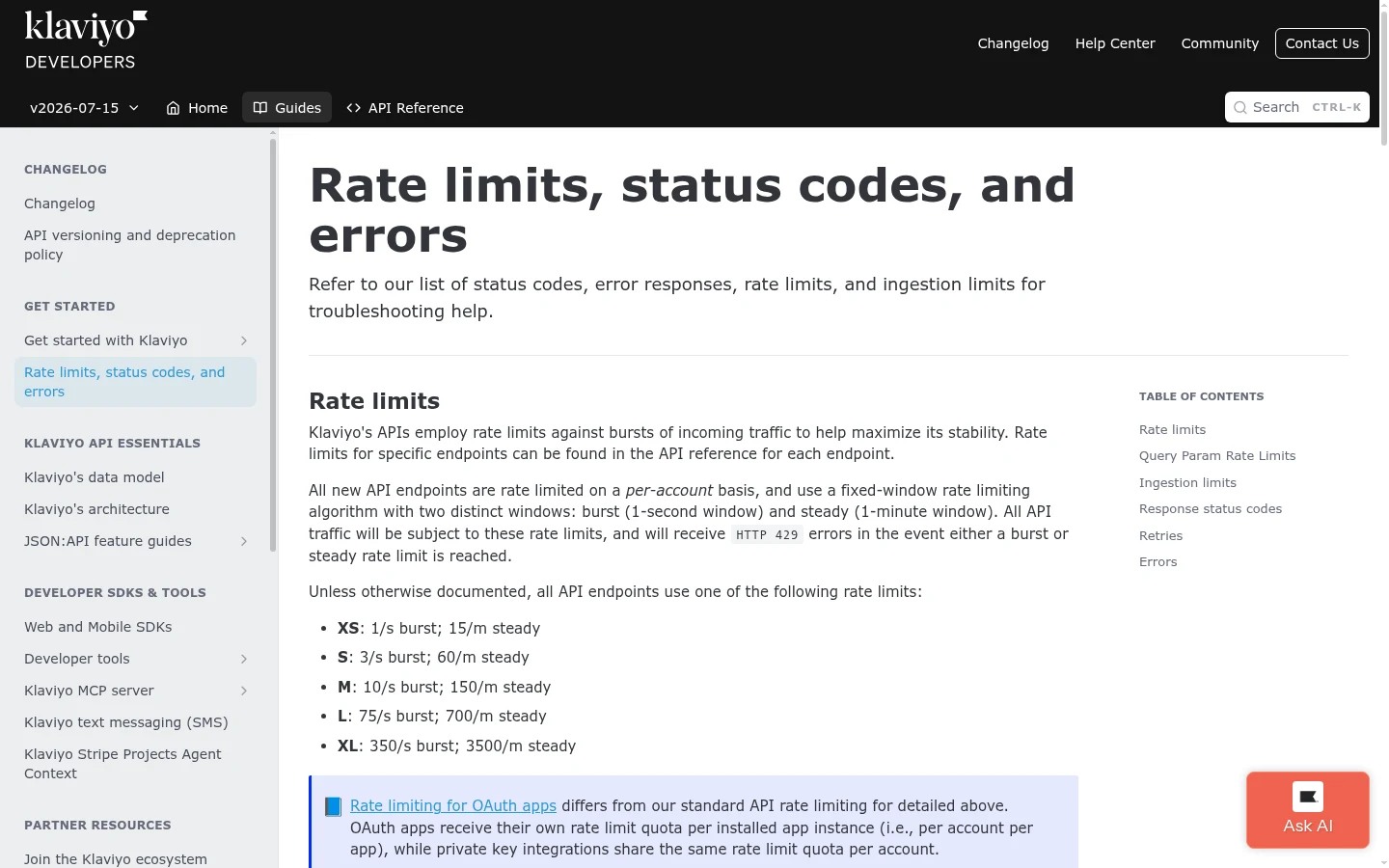
- Five documented API rate tiers, from 1/s to 350/s burst, with RateLimit headers
- G2 rating of 4.6/5 across 1,362 reviews, 76% of them five-star
- Bill scales with active profiles: $100 at 5,000, about $720 at 50,000 on the Email plan alone
- Trustpilot sits at 1.6/5 across 369 reviews, mostly billing and support complaints
- Per-account API limits: the top XL tier sustains 3,500 requests per minute, about 58 per second
Free plan: 250 active profiles, 500 emails a month
How we audited it, and what we did not do
- Tested for
- 8 days
- Plan paid
- None. Public free-plan and pricing pages audited, no paid account
- Version tested
- Public site and API docs v2026-07-15 default, scraped 1 October 2026
- Prompts run
- 0
- Test period
- 2026-09-24 → 2026-10-01
This is a desk audit, not a hands-on production test. Between 24 September and 1 October 2026 we scraped Klaviyo's live pricing page, its developer documentation (default version v2026-07-15) and its product pages, then cross-checked the active-profile price curve against four independent pricing guides. We pulled ratings from G2, Capterra, TrustRadius and Trustpilot on 1 October and read the ten most recent G2 reviews in full. We did not send mail through Klaviyo, so we publish no deliverability or latency numbers. Every figure on this page is either quoted from a vendor page, a review platform, or computed from those quotes, and each carries its source.
Who should pick Klaviyo, and who should not
YES if you...
- Ecommerce teams on Shopify, WooCommerce or BigCommerce that want order and browse events in the profile without writing a sync
- Growth leads who need segments on predicted CLV, churn risk or next order date
- Teams where email revenue per active profile clearly exceeds $0.02 a month
NO if you...
- Engineering teams that need an SMTP-style transactional API with per-send pricing
- Publishers and SaaS products with large, low-intent lists, where active-profile billing punishes you
- Anyone who needs phone support on a small plan: the free tier includes email support for 60 days only
The price is a function of list size, not of volume sent
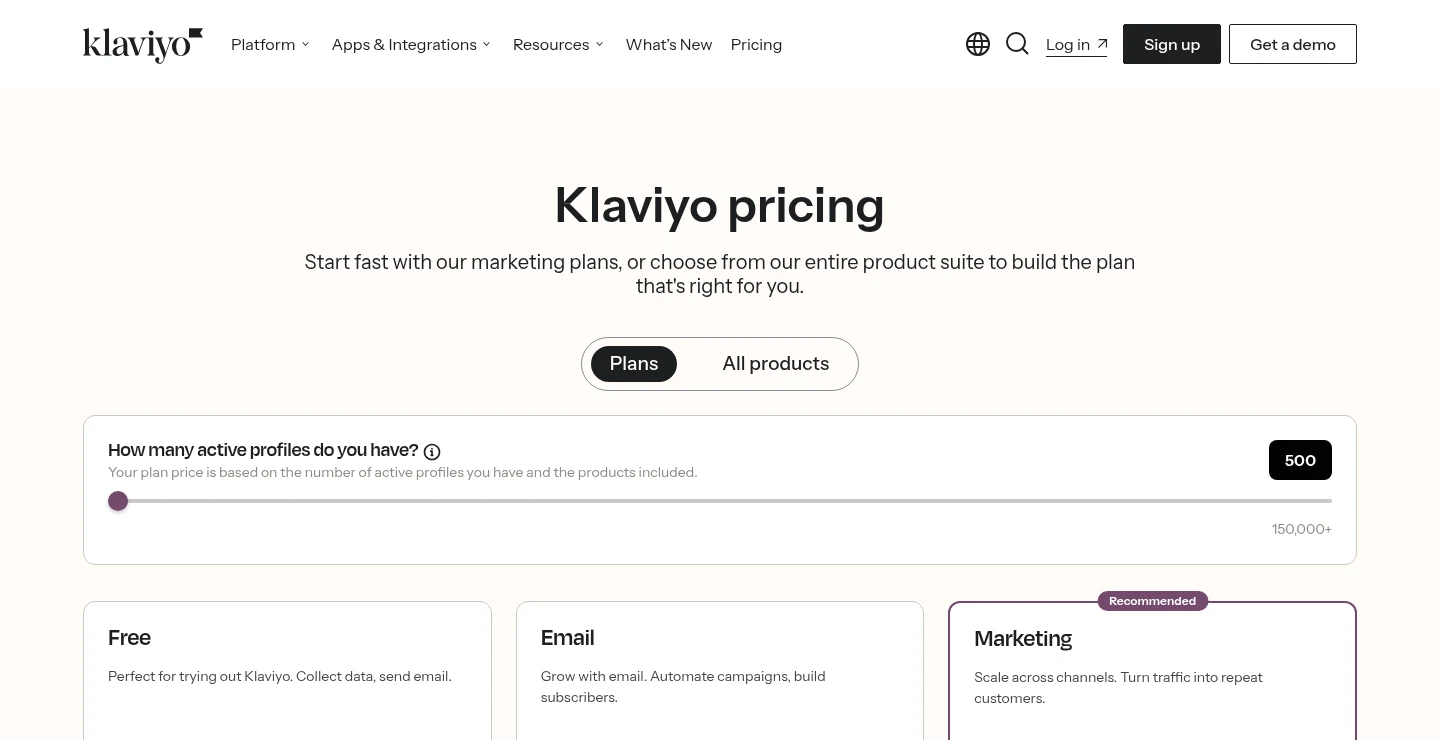
Prices read from the live pricing page with the slider at 500 active profiles.
Free
Up to 250 active profiles
- 500 email sends per month
- $5 of mobile messages per month
- $5 of Composer usage per month
- Email support for the first 60 days
5,000 sends per month at this size
- 350+ integrations
- A/B testing
- Generative AI for content, images and segments
- Security features for sender reputation
- First month discounted by $19 on the live page
Marketing
Recommended tier on the page
- Everything in Email
- Mobile push and in-app messages
- Predictive analytics
- Onsite personalization and product recommendations
- Loyalty rewards, order tracking, self-service Customer Hub
ROI breakdown: Email plan, third-party tables cross-checked: $100 at 5,000 profiles ($0.020 each), $150 at 10,000 ($0.015), $400 at 25,000 ($0.016), $720 at 50,000 ($0.0144). Per-profile cost falls 28% from 5k to 50k, yet the monthly bill rises 7.2x.
Hidden costs & gotchas
- Sends are capped per plan: 5,000 a month at 500 profiles, roughly 10 per profile
- Past the free limits, sending pauses until you upgrade, per Klaviyo's own FAQ
- Active profiles are what you can email, so list hygiene becomes a billing lever
- Add-ons such as review collection are priced separately, so the plan price is rarely the invoice total
The slider is the product: every plan reprices from the profile count
The pricing page opens on a 500-profile slider that runs to 150,000+. Move it and all three plan prices change. That is the cleanest statement of the model: Klaviyo sells access to a profile base, and email is one product billed against it.
- Slider range: 500 to 150,000+ active profiles
- Plan tabs: Free, Email, Marketing, plus an all-products view
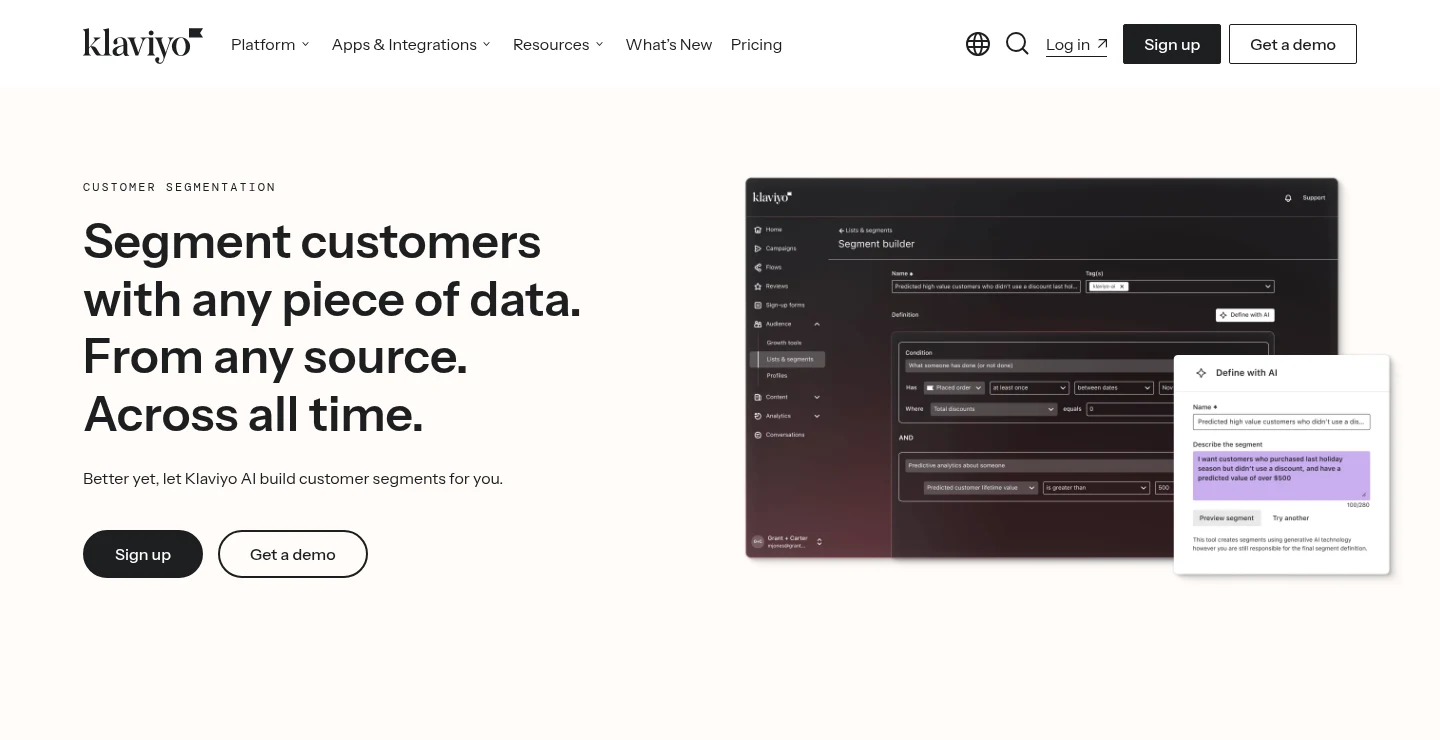
Segments can be built on a prediction, not just on history
The segment builder in the vendor's own screenshot combines an event condition (placed order, at least once, between dates) with a predictive condition (predicted customer lifetime value greater than 500). A Define with AI panel turns a sentence into those conditions. We saw the interface on the product page only, so treat the accuracy of the predictions as unverified.
- Event conditions plus predictive analytics in one definition
- Natural-language segment definition, with a preview step
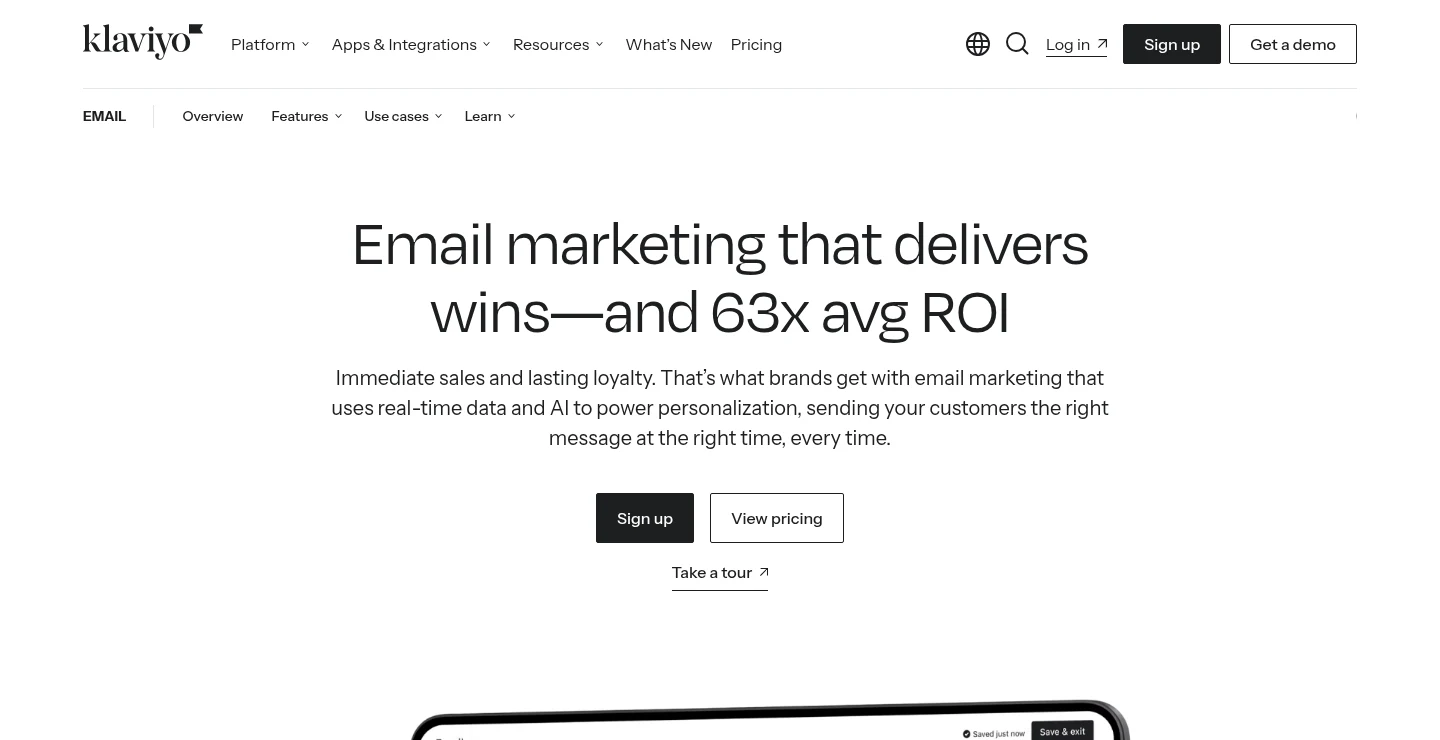
The 63x average ROI claim is a vendor number, not ours
The email product page headlines a 63x average return. It gives no cohort, period or definition on the page we audited, so we do not use it in the score. The same page makes a plainer promise that is easier to test: real-time profile data feeding personalization at send time.
What we measured, and where each number comes from
All figures are sourced from vendor pages and review platforms on 1 October 2026. None come from sending mail.
- Free plan ceiling
- 250 active profiles, 500 sends a month Klaviyo pricing page, scraped 1 Oct 2026
- Entry price, Email plan
- $20 per month at 500 profiles $0.04 per profile; pricing page, slider at 500
- Email plan at 5,000 profiles
- $100 per month Third-party tables (SendX, Retainful, Mailsoftly) agree
- Email plan at 50,000 profiles
- $720 per month 7.2x the 5,000-profile bill for 10x the profiles
- Top API tier (XL)
- 350 requests/s burst, 3,500/min steady Developer docs v2026-07-15; 3,500 / 60 = about 58 per second sustained
- Event payload limit
- 300 properties per event Also 100 kB per field, 10 nesting levels, 5 MB per payload
- G2 rating
- 4.6 /5 across 1,362 reviews 76% five-star, 1% one-star
- Trustpilot rating
- 1.6 /5 across 369 reviews Other snapshots read 1.5 to 2.4, so the trend matters less than the themes
Read Klaviyo's documented rate-limit tiers and convert the top tier to sustained throughput.
Price a 500-profile list on the live pricing slider and read the three plans.
Inspect the segment builder for a prediction-based audience.
Pros and cons, with the evidence behind each
Pros
- Segmentation is the strongest feature across all platforms G2 users cite segmentation and ease of use more than anything else (ease of use, 167 mentions). The vendor builder adds predictive conditions.
- Documented, tiered API rate limits with headers Five tiers, RateLimit-Limit, RateLimit-Remaining and RateLimit-Reset on every non-429 response, Retry-After on a 429. That is enough to build a client with proper backoff.
- Broad integration surface 350+ integrations on the pricing page, 400+ in the G2 description, 87 verified on G2. The numbers disagree, the direction does not.
Cons
- Active-profile billing punishes large, low-intent lists The Email plan goes from $100 at 5,000 profiles to $720 at 50,000. A Reddit user reports about $700 a month for a three-person business.
- Support and billing trust is weak on Trustpilot 1.6/5 over 369 reviews, with recurring posts about billing disputes, account suspension and slow support. G2 also tags poor customer support 39 times.
- Not a per-send transactional email API Klaviyo is built around profiles and events. If you need raw sends priced per message, you will be comparing against a different product class.
- Learning curve on advanced flows and reporting G2 tags learning curve 63 times. Reviewers say reporting needs digging through several views to find one metric.
Klaviyo is strong software with a pricing model you must price first
Klaviyo does one thing very well: it turns commerce events into segments and flows without a sync layer you maintain. The ratings on G2 and Capterra, both 4.6/5 on 1,901 reviews combined, reflect that.
The two risks are structural, not cosmetic. Active-profile billing means the bill follows your list, not your revenue. And the Trustpilot score of 1.6/5 means that when billing or account problems hit, a share of customers feel unsupported.
If you run a store where each active profile is worth well over $0.02 a month, price the 5,000 and 25,000 tiers before you commit and keep the free plan as a test bed. If you are an engineering team that wants email as a priced-per-send primitive, you are shopping in the wrong category. We scored it 7.2 out of 10 on public evidence only, and we would revise that after a paid production test.
- Segmentation and data model 9/10 Predictive conditions, AI definitions
- API and ingestion 7.5/10 Documented tiers, per-account ceilings
- Pricing at scale 5/10 $720 at 50,000 profiles
- Support and billing trust 4.5/10 Trustpilot 1.6/5
- Integrations 8.5/10 350+ on the pricing page
Common questions about Klaviyo
Is Klaviyo free?
How much does Klaviyo cost per month?
Why are Klaviyo reviews so different on Trustpilot and G2?
What are Klaviyo's API rate limits?
Does Klaviyo bill by emails sent or by contacts?
Can Klaviyo replace a transactional email service?
What are the main alternatives to Klaviyo?
Update log
- Initial publication. Desk audit of pricing, API limits and four review platforms; no paid account used.